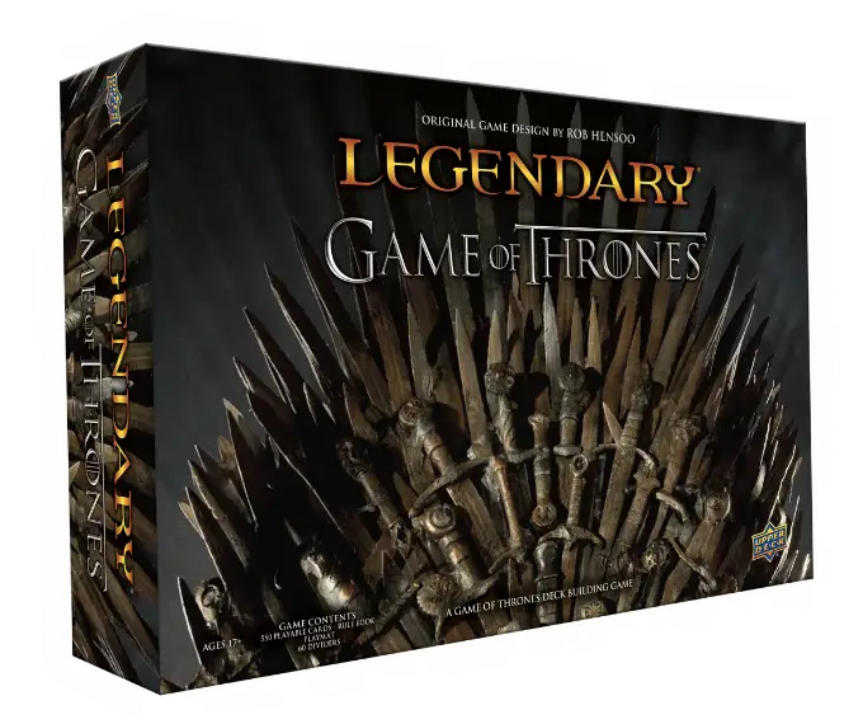
Legendary: Game of Thrones
Gameplay
Objective
Earn the most Victory Points! Defeat enemy allies, support friendly allies, and capture bystanders to earn Victory points. When one player has lost three of their masterminds or a total of six masterminds have been defeated, the game ends. The player with the most Victory Points wins.
Set Up (2-player)
You need the main playing board (the one that has a map on it) and two personal playing boards. Choose one player to be the Starks and one player to be the Lannisters and insert the representative house crest into your personal playing board.
Decks:
- Personal Decks
- Each player’s personal deck is made up of 6 Merchants, 4 Soldiers, and two minor hero cards, selected randomly.
- Hero Deck
- There are 18 different Heroes that each come with a deck of 14 cards: 2 Uncommon cards each with 5 copies, 1 Uncommon card with 3 copies, and a Rare card. Each player gets 4 Heroes and their corresponding 14-card decks
- Starks: Kingdom of the North; Lord Eddard Stark; Winter is Coming; Young Arya
- Lannisters: Hound & Mountain; Jaime Lannister; Queen Cersei; Tyrion Lannister
- Ally Deck
- Each house has a few different Allies & Henchmen. To make up the Ally Deck, each House sends in an Ally group and a Henchman group. In a two-player game, you also add in one ally or henchmen group from each of the other two houses
- Starks: The North and Stark Bannermen
- Lannisters: Siblings & Comrades and Redcloaks
- From other houses: King’s Law and King’s Guard
- Also add: 12 random cards from the Event deck, 8 master strike cards, and 4 bystanders (drawn from the Bystander deck)
- Each house has a few different Allies & Henchmen. To make up the Ally Deck, each House sends in an Ally group and a Henchman group. In a two-player game, you also add in one ally or henchmen group from each of the other two houses
- Bystander Deck
- Shuffle together the Bystander cards and the remaining minor hero cards
- There are 18 different Heroes that each come with a deck of 14 cards: 2 Uncommon cards each with 5 copies, 1 Uncommon card with 3 copies, and a Rare card. Each player gets 4 Heroes and their corresponding 14-card decks
Main Playing Board
- The Bystander Deck, Wound Deck, and Maester deck go face up in their respective spots. The Event Deck is face down, as well as the ally deck
Personal Playing Board
- The 5 Mastermind cards go face up in the Mastermind spot
- The bottom two Defender cards should be face down, with the remaining three face up directly on top.
- The Hero deck goes in the Protagonist pile spot
- Flip the top 5 cards from your hero deck and place them face up in House spots
Draw six cards from your 12-card personal deck to make up your starting hand. Each player starts with three Victory Point Tokens. You are now ready to play.
On Your Turn:
On your turn, you can use the cards in your hand to attack and/or recruit.
Take stock of your hand. Initially, it will consist of merchants (which offer recruit points), soldiers (which offer attack points), and minor heroes (which can offer both recruit and attack points, and usually a special ability as well). As the game goes on, you will have heroes, Maester cards, event cards, and wound cards in your hand as well.
Flip over the top card from the Ally deck and place it in the Bow section of the battlefield. It will be one of the following cards: friendly ally, neutral ally, enemy ally, master strike, bystander or minor hero, or event.
- If it is a friendly ally, you can spend attack points to move it down the battlefield towards the escape.
- If it is a neutral or enemy ally, you can spend attack points to defeat the ally and add it to your victory pile, earning a Victory token.
- If it is a master strike, move the top Mastermind card of the player whose turn it is to the bottom of their Mastermind stack. Then read the “Master Strike” effect of the Mastermind that is now on top. Do what it says and put the Master Strike card in the KO pile (general discard pile, which is separate from your personal discard pile)
- If it is a bystander or minor hero, it gets captured by an ally. Put it under the ally in the range space that is closest to the ally deck. If there are no allies in play, then the bystander goes into the victory pile of the player whose turn it is.
- If it is an event, you must first address the lineup cycling effect. Each event has a number (1-5) which correspond with the lineup spaces on a player’s personal board. Each player must cycle the corresponding card out (put it at the bottom of your hero deck) and replace it with the top card from the hero deck. Then, follow the instructions of the event.
You can spend your attack points as you see fit:
- Attack a neutral and enemy ally and add it to your victory pile. You also earn a Victory token.
- Attack a friendly ally to support it, moving it one space down the battlefield
- Attack your opponent’s defenders. These cards defend masterminds, which cannot be attacked unless all defenders have been defeated.
- If you have enough points and defenders have been defeated, you may attack your opponent’s mastermind.
- If you have 5 attack points and it costs 3 points to attack an enemy ally and 2 points to attack a defender, you can do both.
You can spend recruit points to purchase heroes to add to your discard pile, which will then be cycled into your hand for future rounds.
As the game goes on, you will have more complex cards cycled into your hand. By more complex, I mean the text on each card will instruct you to do different things, which can advance your gameplay.
If you attack an ally on the battlefield, you remove it from the battlefield and add it to your victory pile. You also must do what the “Fight” instruction says. The ally will also indicate how many victory tokens you earn for defeating it.
If you flip over an ally card and it is not from the same house as what’s already in the Bow space, move the card that’s in the Bow space over to the Spear space. If it’s from the same house, both cards can exist in the space. However, each space can only hold three cards of the same house.
If all five battlefield spaces are full and you flip over the top card from the ally deck and it can’t be added to the card already in the Bow space, battlefield positions shift, meaning the card(s) in the Claw space move into the Escape space.
- If the ally that escapes belongs to one of the players, that player gains one victory token
- If the ally had one or more bystanders captured, they go into the victory pile of the ally’s owner. Bystanders captured by an escaped neutral ally go into the KO pile.
- If the ally was not from your house and you have six or more cards in your hand, you must discard a card. If it’s a neutral ally, all players with six or more cards in their hand must discard a card.
- If the ally has an escape effect on its card, do what it says
The new ally card may have an “Ambush” effect. After moving cards down the battlefield (if necessary), immediately do what the Ambush effect says. If the battlefield movement resulted in an ally escaping, do the escape effect first.
Maester, Wound, Event, and Bystander cards will come into play as the game goes on, so you don’t have to worry about them initially.
History
Legendary: Game of Thrones is brought to you by Upper Deck. Upper Deck is a trading card company that’s been around since 1989, when they launched their first baseball trading card set. While the business was built on sports trading cards, it’s since evolved into the world of entertainment, too. Upper Deck was an idea first thought of by Paul Sumner back in 1987. He worked in printing sales at the time and came up with the idea for a premium card. The rest is history!
This is an extensive and very in-depth game, so I want to shout out everyone involved in its production:
- Game Design and Card Set Design: Rob Heinsoo
- Associate Designer: Chris VanMeter
- Director of Entertainment Brands: Travis Rhea
- Brand Manager: Corrine Deng
- Director of Game Development: Bubby Johanson Sr.
- Game Developer: Mark Shaunessy
- Product Manager: Rob Ford
- Game Developer: Case Lopez
- Game Development Coordinator: Zack Stevens
- Graphic Design: Krista Timberlake
- Art Direction: Andrew Ballestros, Erika Klock, Emily Mazza
- Card art: Andrea Adiletto, Federico Bertoni, Katherine Lobo, Matteo Meloni, Jaka Prawira, Riccardo Robaldo
- Project Managers: Keli Lewis, Danny Montejo
- VP of Production and Logistics: Suzanne Lombardi
- President, Upper Deck Company: Jason Masherah
- Playtesters: Chad Brown, Bobby Coovert, Sean Dawson, Maximillian Dennis, Lisa Eschenbach, Miguel Friginal, Trevor Harron, Paul Hughes, Silas Hughes, Rob Lightner, Ryan Martin, Dan Moen, Karen Ressler, Keith Richmond, Jonathan Tweet, Vito Munoz, Rob Watkins
- Original Legendary ® Game Engine Design: Devin Low
Variations
Legendary: Game of Thrones is one of many trading card games created by Upper Deck. On their website, you can also find:
- Legendary: 007
- Legendary: Marvel
- Legendary Encounters: The X-Files
- Legendary: What If…?
- Legendary Encounters: The Matrix



Recent Blogs
The Bloom Report
From Jabba’s Sail Barge to Mos Eisley: How HasLab Made the Impossible Possible

The Bloom Report
Steve Rad on TikTok Shop, Social Commerce and the Next Big Opportunity for the Toy Industry at the Chicago Toy and Game Fair!
General
Toys R Us is Back

The Bloom Report
David Becker and Dr. Amanda Gummer Talk Building Trust, Creating Demand and Helping Children's Brands Grow

Press Release
Plus-Plus USA Returns to the Chicago Toy & Game Fair, Bringing Hands - On Creative Play to Holiday Shoppers
See more
Recent Wiki
BOOK REVIEWS
Book Review: No Experience Necessary: Why Betting on Yourself in Your Twenties Is the Best Decision You’ll Ever Make by Ronnen Harary
PEOPLE
Chris Byrne Chats About His New Book "How To Cremate A Parakeet"
COMMENTARY AND OPINION EDITORIALS
The Toy Association & UIA’s Toy Hub Bring Toy & Game Inventors Together in LA

COMPANIES
“CARVE-X” MAKES LANDMARK MOVE TO THE JAVITS CENTER FOR TOY FAIR 2027
PITCHES: PRODUCT CONCEPTS FOR LICENSING & PRODUCTS FOR RETAIL
People of Play™ Announces Speaker Lineup for 2026 Global Inventor Pitch & Innovation Conference
See more
POP's Got Talent

POP Entertainment
Randy Klimpert Shares his Ukulele Collection
POP Entertainment
Steve Casino Peanut Art
POP Entertainment
Everyone's Talking about POP!
POP Entertainment
Princess Etch - a Multi-Talented Etch A Sketch Artist
POP Entertainment
Joseph Herscher of Joseph' s Machines.
See more
Recent POPcast
Hidden Role: The Brains Behind your Favorite Games
Brent Bushnell talks Two Bit Circus, VR, & STEAM (Part 1)
Hidden Role: The Brains Behind your Favorite Games
Tim Walsh Celebrates the 30th Anniversary of Blurt!
Hidden Role: The Brains Behind your Favorite Games
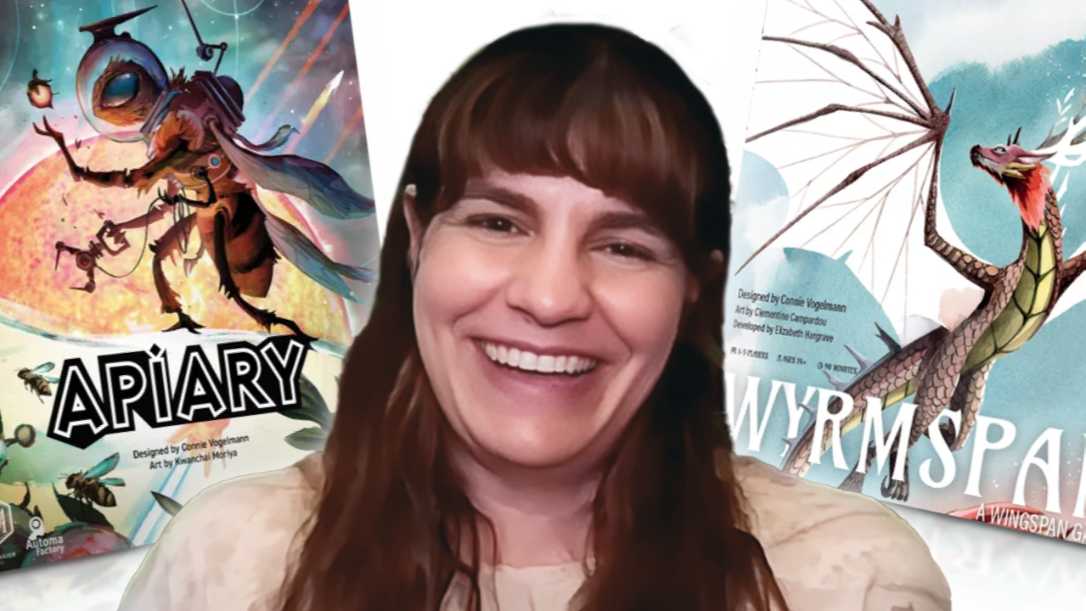
Connie Vogelmann designed Apiary & Wyrmspan!

Hidden Role: The Brains Behind your Favorite Games
Bob Fuhrer... Is THE Crocodile Dentist!

Hidden Role: The Brains Behind your Favorite Games
Tom Dusenberry... Bought Atari, Wizards of the Coast, and Avalon Hill!
See more
POPDuos

POPDuos: Interviews with Legends and Leaders
POPDuo: Richard Dickson, Mattel’s President & COO, and Kedar Narayan, Young Inventor Challenge AMB

POPDuos: Interviews with Legends and Leaders
POPDuo: Will Shortz and Josh Wardle

POPDuos: Legends and Leaders Explore Creativity
POP Duo: Elan Lee, Co-Founder, Exploding Kittens.and Jeff Probst, Host and Exec Producer, Survivor

POPDuos: Legends and Leaders Explore Creativity
POP Duo: David Fuhrer, MNG Director, Blue Sq Innovations & Shawn Green, past Dodgers & Mets MLB Star

POPDuos: Legends and Leaders Explore Creativity
POP Duo: Bob Fuhrer, Founder, Nextoy and Tom Fazio, Golf Course Designer
See more
Featured Articles

The Bloom Report
Toy Inventors--The Heart and Soul of the Industry
The Bloom Report
Brian Turtle: 'Endless' Stories, Advice, Kevin Bacon and More! tBR Person of the Week
Biographies and Interviews
Jonathan Levy on Jon2.0 - from Co-Founding Mastermind Toys to Spin Master
Biographies and Interviews
Andrew Perlmutter's Journey from Glencoe to Funko with Crazy Ideas that turned out Golden
See more