
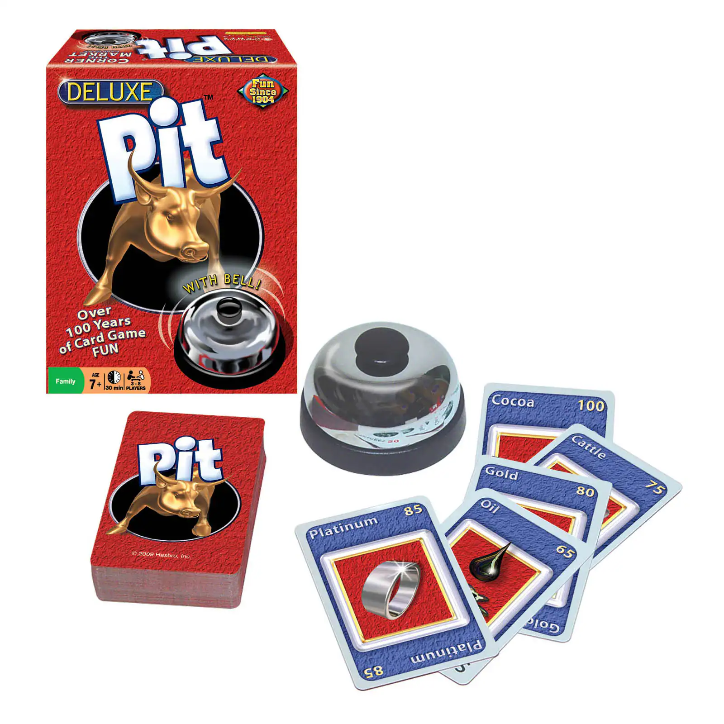
Pit
Gameplay
If you like fast-paced games where everyone is shouting at once, you’re going to love Pit. Based on the Chicago Board of Trader (lovingly known as the Pit) and the Us Corn Exchange, it’s a game that’s supposed to simulate open bidding for commodities.
You need at last three players and at most eight. The game comes with 63 cards, with nine cards each of seven different commodities (later versions added an eighth commodity plus a Bull card and a Bear card, making the total number of 74 cards, but more on that later). In the original version, the commodities were Wheat, Barley, Corn, Rye, Oats, Hay, and Flax. In the newer versions, the list includes Wheat, Barley, Coffee, Corn, Sugar, Oats, Soybeans, and Oranges.
Each commodity has a certain value. The object of the game to collect all nine commodity cards. Once you do, call out “Corner on the___!” (fill in the blank on the commodity you’ve cornered) and reveal your cards. You earn however many points your commodity is worth, and that round is over. The game ends once a player reached an agreed-upon point total.
The fun thing about Pit is that there’s no turns—everyone plays at once. Players blindly exchange anywhere from one to four cards with other players by calling out how the number of cards you wish to trade until another player agrees. The cards are exchanged face down.
Back to the Bear and the Bull. This addition comes with the newer versions of the game, and means that two players will be dealt 10 cards while the others are dealt nine. You do not want the Bear card—if you have it, you can’t declare a Corner even if you have all commodity cards. The Bull card, though, is a wild card, and can be used to complete any set. You can use it in three ways:
- Holding all nine cards of the same commodity with or without a 10th card in hand
- Holding eight cards of the same commodity and the Bull
- Holding all nine cards of the same commodity and the Bull, which means you get double the points!
Unfortunately, at the end of the round, if you are not the winner and you are holding the Bull or the Bear, you get a 20-point penalty. Note: the Bull and the Bear can be traded individually or with any number of cards of one commodity.
History
The first edition of Pit came out in 1903 and it is generally agreed that Edgar Cayce is the designer. However, it is likely that he stole the idea from the game Gavitt’s Stock Exchange, invented by Harry Gavitt, who says he thought up his game in 1896. He didn’t copyright and publish it until 1903, though.
Pit first went on sale in 1904 and was published by Parker Brothers, which is now owned by Hasbro.
Variations
There are a few games out there that are extremely similar to Pit:
- Billionaire
- Business:
- Cambio
- Quick 7
- Zaster
Reception & Awards
In the December 1972 publication of Games and Puzzles, Pit was featured, described as “an invaluable asset to any household: a marvelous ice-breaker and an infallible device for sending the older members of the family to. Bed when the party’s over (for them).”
Pit was also featured in the November 1980 publication of GAMES Magazine, with the cheeky description: “Rumor has it that Nelson Bunker Hunt never won a game of Pit in his life.”
[Nelson Bunker Hunt was an American oil executive whose billionaire fortune collapsed after he and his brothers tried to corner the world market in silver. The government stopped him.]
In 2010, Pit was named Family Games: The 100 Best, in which top designers and publishers wrote about the most enjoyable and cleverly designed games of the last 100 years. The reviewer of Pit? John Wick
Recent Blogs



Recent Blogs

The Bloom Report
Brian Weiss: Goliath Takes Action Against Counterfeit Clickeez
General
Katherine Kaiser: The World Of Test Modes and Revision Numbers In Bop It
The Bloom Report
Liam O'Malley Talks Working on the Bloom Report, Collecting Toys, and Innovation in the Toy Industry
The Bloom Report
Anthony Elder Talks Building Stimeez, The Design Process, and Making Toys That Address Kids' Needs
Press Release
CONNETIX Launches New PRO Build It 4 Ways Packs Inspiring Older Builders through Advanced Play
See more
Recent Wiki
BOOK REVIEWS
Game Review: Yahtzee

COMPANIES
Spielwarenmesse Invitation for game authors: Registration until 15 December 2026
BOOK REVIEWS
Game Review: Peekimo

PEOPLE
Peter Cullen and the Voice That Helped Transform a Toy into an Icon

PEOPLE
Fei Feng Talks Growing Orbio, Leading with Joy, Inspirations and More!
See more
POP's Got Talent

POP Entertainment
Randy Klimpert Shares his Ukulele Collection
POP Entertainment
Steve Casino Peanut Art

POP Entertainment
Everyone's Talking about POP!
POP Entertainment
Princess Etch - a Multi-Talented Etch A Sketch Artist

POP Entertainment
Joseph Herscher of Joseph' s Machines.
See more
Recent POPcast

Hidden Role: The Brains Behind your Favorite Games
Brent Bushnell talks Two Bit Circus, VR, & STEAM (Part 1)

Hidden Role: The Brains Behind your Favorite Games
Tim Walsh Celebrates the 30th Anniversary of Blurt!
Hidden Role: The Brains Behind your Favorite Games
Connie Vogelmann designed Apiary & Wyrmspan!

Hidden Role: The Brains Behind your Favorite Games
Bob Fuhrer... Is THE Crocodile Dentist!

Hidden Role: The Brains Behind your Favorite Games
Tom Dusenberry... Bought Atari, Wizards of the Coast, and Avalon Hill!
See more
POPDuos

POPDuos: Interviews with Legends and Leaders
POPDuo: Richard Dickson, Mattel’s President & COO, and Kedar Narayan, Young Inventor Challenge AMB

POPDuos: Interviews with Legends and Leaders
POPDuo: Will Shortz and Josh Wardle

POPDuos: Legends and Leaders Explore Creativity
POP Duo: Elan Lee, Co-Founder, Exploding Kittens.and Jeff Probst, Host and Exec Producer, Survivor

POPDuos: Legends and Leaders Explore Creativity
POP Duo: David Fuhrer, MNG Director, Blue Sq Innovations & Shawn Green, past Dodgers & Mets MLB Star

POPDuos: Legends and Leaders Explore Creativity
POP Duo: Bob Fuhrer, Founder, Nextoy and Tom Fazio, Golf Course Designer
See more
Featured Articles

The Bloom Report
Toy Inventors--The Heart and Soul of the Industry
The Bloom Report
Brian Turtle: 'Endless' Stories, Advice, Kevin Bacon and More! tBR Person of the Week

Biographies and Interviews
Jonathan Levy on Jon2.0 - from Co-Founding Mastermind Toys to Spin Master
Biographies and Interviews
Andrew Perlmutter's Journey from Glencoe to Funko with Crazy Ideas that turned out Golden
See more